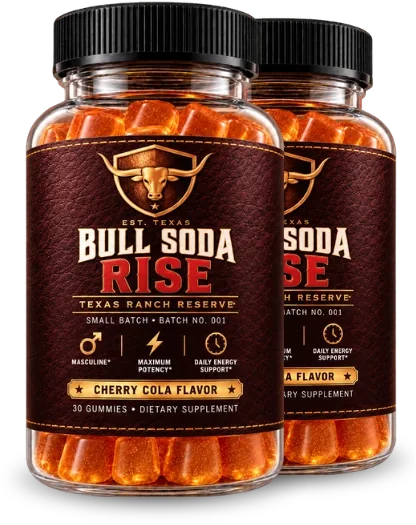
What does 20:1 extract mean? It means the extract was concentrated from about 20 parts of plant to 1 part of extract, and Bull Soda Rise Gummies print it after four names: Panax ginseng, maca root, rhodiola and grape seed 1.
The ratio describes how the extract was made. It does not tell you how much of any active compound sits in a gummy, so we do not convert it into an "equivalent" amount. Below we show what it tells you, what it hides and what to ask.
What is a 20:1 extract ratio?
A 20:1 ratio is a plant-to-extract ratio: about 20 parts of the raw plant were concentrated into 1 part of extract. The ratio is printed with the ingredient name, as in "Panax ginseng extract (20:1)" 1.
A simple picture helps. If a maker starts with 20 kilograms of dried plant and ends with 1 kilogram of extract, the ratio is 20:1. The example is only arithmetic for illustration; it is not a figure about our product, whose batch sizes we do not know.
A higher first number means more plant went into each part of extract. That is all the number says. It is a statement about the process, not about the content of the finished gummy.
What does the 20:1 ratio not tell you?
It does not tell you the milligrams of the plant, the milligrams of any active compound, or how a gummy compares with a study dose. We say this plainly because a ratio looks like a measurement of strength, and it is not one.
| Question | Does 20:1 answer it? |
|---|---|
| Was the plant concentrated? | Yes, about 20 parts into 1 |
| How many mg of the extract are in a gummy? | Only where the line shows an amount |
| How much active compound is inside? | No |
| How does it compare with a studied dose? | No |
| Is the product effective? | No |
For a clear view of the effect question, public sources say the evidence is limited or mixed for the herbs involved. NCCIH reports conflicting or no-benefit findings for several ginseng uses 2, and says there is not enough reliable evidence to say whether rhodiola is useful for any health purpose 3. We make no claim that this gummy does anything, and those findings do not turn a 20:1 line into a dose.
It is also worth separating a ratio from a standard. A line that named a specific compound and its percentage would be a different kind of statement, and the listing we read prints no such figure.
Where do Bull Soda Rise Gummies print 20:1?
The ratio appears on four lines of the Supplement Facts listing: grape seed extract, Panax ginseng extract, maca root extract and rhodiola extract 1. Only one of those four has its own amount.
| Line | Own amount shown |
|---|---|
| Grape seed extract (20:1) | 25 mg |
| Panax ginseng extract (20:1) | No, inside the 200 mg blend |
| Maca root extract (20:1) | No, inside the 200 mg blend |
| Rhodiola extract (20:1) | No, inside the 200 mg blend |
The three blend items are listed in order of weight, which makes ginseng the largest share and rhodiola the smallest, but the split is not shown 4. Our page on the proprietary blend explains the 200 mg line, and the grape seed extract page covers the 25 mg one.
Why the ratio is easy to misread
Because it looks like strength, people read 20:1 as "20 times stronger". That reading is wrong, as the ratio compares plant to extract and says nothing about the final amount or the compounds inside.
- It does not multiply the milligram amount on the label.
- Two 20:1 extracts from different plants contain different things.
- A 20:1 line inside a blend still hides its own amount.
- A ratio printed by the seller is not evidence from a lab; it is the seller's statement.
The FDA says makers are responsible for the safety and labeling of their supplements, and that FDA acts after products are on the market 5. A printed ratio is therefore a claim on the label that the buyer cannot check alone.
What can you ask the order desk about 20:1?
You can ask for the figures the label leaves out. The order desk is the right first contact, at +1 (302) 200-3480, because the brand information page gives no phone and says to compare its figures with the physical label 1.
- What are the milligram amounts of ginseng, maca and rhodiola inside the 200 mg blend?
- Is there a certificate of analysis for my lot, and can you read me the lot number it covers?
- What was the plant source and extraction method behind each 20:1 line?
- Does the Supplement Facts panel on my bottle match the brand page?
We do not know the answers, and we have not seen the back label photo, so we cannot say whether a certificate exists. Our Supplement Facts walk-through lists the other lines to compare. Read the guidance from FDA on blends and labeling if you want the rules behind the panel 4.
Frequently asked questions
What does 20:1 mean on Bull Soda Rise Gummies?
It means each extract was concentrated from about 20 parts plant to 1 part extract 1. It does not give the amount of any active compound in a gummy. Only grape seed shows its own amount, 25 mg.
Is 20:1 extract in Bull Soda Rise Gummies stronger than a normal herb?
The ratio alone cannot say. It describes how much plant went into the extract, not how much of any compound is in a gummy or how that compares with another product. We make no strength claim.
Which Bull Soda Rise Gummies ingredients are 20:1 extracts?
Four: grape seed, Panax ginseng, maca root and rhodiola 1. The last three share a 200 mg proprietary blend with no individual amounts, so their own milligrams are unknown.
Can I work out the ginseng in Bull Soda Rise Gummies from the 20:1 ratio?
No. The ratio does not convert to a plant or compound amount, and the blend shows only a 200 mg total 4. Ask the order desk if you want amounts, and expect that they may not share them.
Sources for this page
- Bull Soda Rise brand information page with the Supplement Facts listing, read on Nov 25, 2026
- NCCIH: Asian Ginseng: Usefulness and Safety
- NCCIH: Rhodiola: Usefulness and Safety
- FDA: Dietary Supplement Labeling Guide (Supplement Facts panel, serving size, proprietary blends)
- FDA: Questions and Answers on Dietary Supplements
Label words come from photos of the Bull Soda Rise bottle front. Supplement Facts come from the brand information page and owner pack; prices and guarantee wording from the seller order page as read on Nov 25, 2026. Confirm them on your bottle and at checkout. Where sources differ, the printed label wins.