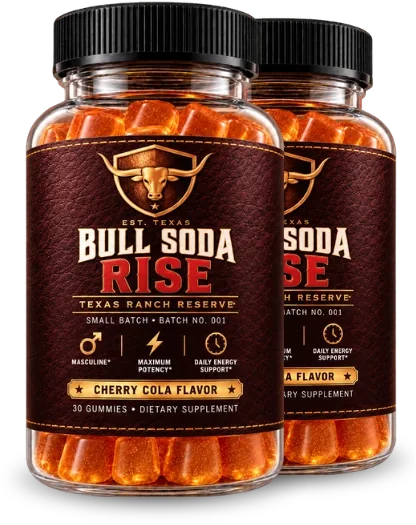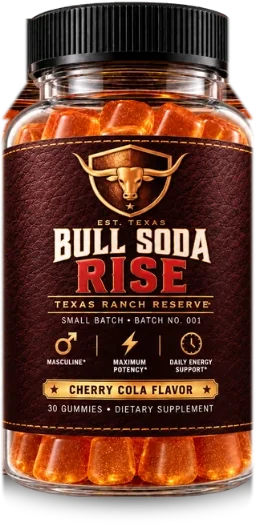
The Bull Soda Rise Gummies proprietary blend is a single 200 mg line that names three herbal extracts, in this order: Panax ginseng extract (20:1), maca root extract (20:1) and rhodiola extract (20:1) 9. It is the largest listed item in each gummy, but it gives no amount for any one herb.
This page explains what a proprietary blend is under FDA labeling rules, what the listing order does and does not tell you, what the "20:1" printed after each name means, and why nobody outside the maker can say how the 200 mg is split. It ends with questions worth asking the order desk before you buy.
What is in the Bull Soda Rise Gummies proprietary blend?
The blend lists three extracts with a combined weight of 200 mg per gummy: Panax ginseng, maca root and rhodiola. Each name carries the extract ratio 20:1.
- Panax ginseng extract (20:1), listed first
- Maca root extract (20:1), listed second
- Rhodiola extract (20:1), listed third
The owner pack gives the same three names, the same order and the same 200 mg total 1. No individual amounts appear in either source, and we have not seen a back label photo, so check the Supplement Facts panel on your bottle. The rest of the gummy is covered on our ingredients page.
What is a proprietary blend?
A proprietary blend is a group of ingredients listed under one name with one total weight. FDA lets a Supplement Facts panel show the blend's total and list its ingredients in order of predominance by weight, without each ingredient's amount 2.
That is a legal labeling option, not a warning sign on its own. It does mean the reader gets less information than a fully itemized panel would give. The other actives in Bull Soda Rise Gummies, such as niacin 25 mg and L-citrulline 35 mg, have their own stated amounts; only the three herbs are grouped.
Supplements are not approved by FDA before sale, and makers are responsible for their labels 3. So the blend format is a choice the maker made, and only the maker can fill in the details.
For a reader, the useful habit is to read a blend total as a ceiling. The 200 mg is the most any one of the three herbs could weigh in a gummy, and in practice each herb is some smaller part of it. That ceiling is the only firm number the label gives for ginseng, maca or rhodiola.
Source: Bull Soda Rise brand information page and owner pack, read Nov 25, 2026.
What does the listing order of the panax ginseng maca rhodiola blend tell you?
The order tells you which herb weighs most and which weighs least: Panax ginseng is the largest share and rhodiola the smallest. It tells you nothing more precise than that.
Because the total is 200 mg and the items are in descending order, ginseng must make up at least a third of the blend by weight, and rhodiola at most a third. Those are bounds from logic, not estimates of the real split. The real figures could be close to even or very lopsided, and the label does not say which.
We do not print guessed amounts for any of the three herbs, and you should be wary of any page that does. If you see a milligram figure for ginseng, maca or rhodiola in Bull Soda Rise Gummies, ask where it came from.
What does 20:1 mean on the blend?
"20:1" is an extract ratio: about 20 parts of raw plant were concentrated into 1 part of extract. It describes how the extract was made, not how much active compound ends up in a gummy.
A ratio is sometimes multiplied to suggest an "equivalent" amount of raw herb. We do not do that, because a ratio says nothing about which compounds were kept, how much of each, or how the extract was standardized. Two 20:1 extracts of the same plant can differ.
The ratio is also printed identically on all three herbs, so it does not help you rank them. Only the listing order does that. If an extract standard matters to you, ask the order desk whether any of the three is standardized to a named compound.
The same ratio is printed on the grape seed extract line, which does have its own amount of 25 mg. See our grape seed extract page for that line.
What do public sources say about each herb in the 200 mg blend?
Public sources describe the evidence for all three herbs as limited, mixed or insufficient. None of these sources studied Bull Soda Rise Gummies or its 200 mg blend.
| Blend item | Order | What we know | Our page |
|---|---|---|---|
| Panax ginseng extract (20:1) | 1st, largest share | Amount not shown. NCCIH says short-term use up to 6 months appears safe for most people and insomnia is the most common side effect. | Panax ginseng |
| Maca root extract (20:1) | 2nd | Amount not shown. MSK says only a few small human trials exist and the evidence is limited. | Maca root |
| Rhodiola extract (20:1) | 3rd, smallest share | Amount not shown. NCCIH says there is not enough reliable evidence to say whether it is useful for any health purpose. | Rhodiola |
NCCIH's ginseng summary covers short-term safety and side effects 4. MSK notes maca is promoted for energy, fertility and sexual desire, with only a few small human trials behind those claims 5. NCCIH says rhodiola is promoted for fatigue, athletic performance, mood and stress, but the evidence is not reliable enough to judge 6. This site does not claim the blend does any of those things.
Why does the Bull Soda Rise Gummies proprietary blend matter for safety questions?
Without individual amounts, a pharmacist cannot compare the herb doses with study amounts or with your medicines. They can only work from the herb names and the 200 mg ceiling.
Each herb has cautions in public sources. NCCIH says ginseng may affect blood clotting and may lower blood sugar, so people with diabetes should ask first. MSK says maca may interfere with testosterone lab tests and advises talking to a provider if you take prescription medicines. NCCIH reports a possible interaction between rhodiola and losartan, a blood pressure medicine.
- Ask first if you take diabetes, blood-thinning or blood pressure medicines.
- Tell your doctor before any hormone blood test.
- Ask first if you are pregnant or breastfeeding, or have an autoimmune disorder or a hormone-sensitive cancer.
NCCIH also reminds readers that "natural" does not mean safe 7. Our drug interactions page covers each medicine group.
Can I tell how much of each herb I get?
No. From the label alone, nobody can say how many milligrams of ginseng, maca or rhodiola are in one gummy. Only the maker knows the split.
There is a second layer of uncertainty. MedlinePlus says herbal products are not tested the way medicines are, and labels may not list correct amounts 8. That applies to herbal products in general, not to a known problem with this one.
The practical step is to ask. The owner pack gives a certificate of analysis reference format and suggests asking the order desk for the CoA for your lot. A CoA, if supplied, may or may not break down the blend; it is still worth requesting. See how we check legitimacy for the lot and CoA steps.
What should I ask the order desk about the 200 mg blend?
Ask for the amount of each herb, the extract standard, and a certificate of analysis for your lot. Call +1 (302) 200-3480 or email [email protected] and keep the answer in writing if you can.
- How many milligrams of Panax ginseng, maca and rhodiola are in one gummy?
- Which species of rhodiola and which part of the ginseng plant are used?
- Is any extract standardized to a named compound, and at what level?
- Can you send the certificate of analysis for my lot number?
- Who manufactures the gummies, and where?
If the answers are not available, that is useful to know before a medicine conversation. Bring the bottle and any reply to your pharmacist.
How does the blend compare with the rest of the gummy?
At 200 mg, the blend is the heaviest line on the panel. By our arithmetic the listed actives total 313.5 mg, so the blend is about 64% of the listed active weight.
The remaining 113.5 mg is split across niacin (25 mg), vitamin B6 (2 mg), zinc (1.5 mg), L-carnitine (25 mg), L-citrulline (35 mg) and grape seed extract (25 mg). Those are the lines you can actually compare with public reference amounts, and we do so on pages such as niacin and vitamin B6 and L-carnitine.
A heavier line is not a stronger one. Weight tells you how much extract is listed, not what it does in the body, and we make no claim about the blend's effect.
Frequently asked questions
How many herbs are in the Bull Soda Rise Gummies proprietary blend?
Three: Panax ginseng extract, maca root extract and rhodiola extract, each marked 20:1. Together they weigh 200 mg per gummy, with no individual amounts shown.
Is ginseng the biggest share of the Bull Soda Rise Gummies blend?
Yes. Ginseng is listed first, so it must be the largest share, which means at least a third of the blend by weight. The actual milligram figure is not shown, and we do not estimate it.
Is the Bull Soda Rise Gummies proprietary blend legal to label this way?
Yes. FDA labeling rules allow a blend to show its total weight and list ingredients in order of weight without individual amounts. It does mean less detail for the reader.
Does the 20:1 on the Bull Soda Rise Gummies blend mean 20 times more herb?
No. 20:1 describes how the extract was concentrated. It does not tell you how much active compound is in a gummy, and we do not convert it into an equivalent amount.
Can a pharmacist assess the herbal blend in Bull Soda Rise Gummies?
Only partly. A pharmacist can check the three herb names against your medicines, but cannot compare doses because the split is not shown. Bring the bottle and any answer from the order desk.
Sources for this page
- Bull Soda Rise owner pack (contacts, returns, refund steps, product summary)
- FDA: Dietary Supplement Labeling Guide (Supplement Facts panel, serving size, proprietary blends)
- FDA: Questions and Answers on Dietary Supplements
- NCCIH: Asian Ginseng: Usefulness and Safety
- Memorial Sloan Kettering Cancer Center, About Herbs: Maca
- NCCIH: Rhodiola: Usefulness and Safety
- NCCIH: Safe Use of Complementary Health Products and Practices
- MedlinePlus: A guide to herbal remedies
- Bull Soda Rise brand information page with the Supplement Facts listing, read on Nov 25, 2026
Label words come from photos of the Bull Soda Rise bottle front. Supplement Facts come from the brand information page and owner pack; prices and guarantee wording from the seller order page as read on Nov 25, 2026. Confirm them on your bottle and at checkout. Where sources differ, the printed label wins.